
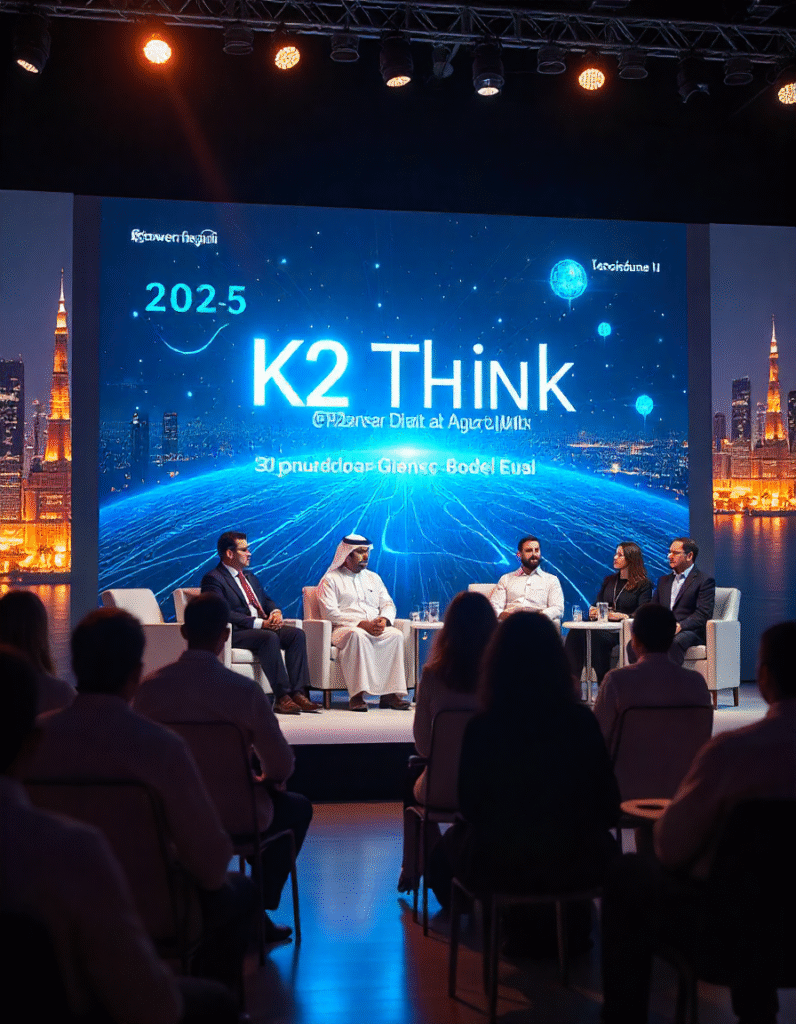
Discover UAE’s K2 Think, an open-source AI model by MBZUAI & G24. Learn how it reshapes enterprise AI, research, and policy for a privacy-first future.
UAE’s K2 Think: Open-Source AI Model from MBZUAI & G24 2025
Introduction
In 2025, the UAE has taken a bold step in the artificial intelligence landscape with the launch of K2 Think, an open-source AI model developed through a strategic collaboration between the Mohamed bin Zayed University of Artificial Intelligence (MBZUAI) and the G24 global technology consortium.
While the world’s major AI players like OpenAI, Google DeepMind, and Anthropic have traditionally dominated the frontier models space, K2 Think signals a fresh, geopolitically significant approach. Unlike many closed-source models that operate as black boxes, K2 Think prioritizes transparency, accessibility, and open innovation, making it a landmark release for enterprises, researchers, and policymakers worldwide.
For U.S. tech leaders, researchers, and enterprises, the launch of K2 Think is not just another AI announcement—it is a statement of AI democratization from the Middle East, challenging the hegemony of Silicon Valley and Western AI ecosystems.
In this article, we will explore the origins, technical architecture, applications, and global implications of K2 Think.
The Rise of K2 Think: Why It Matters
AI models today are at the center of global competition, innovation, and policy. Yet most large-scale models are proprietary, controlled by private corporations, raising concerns about data access, security, and inclusivity.
K2 Think stands out because:
- Open-Source First: Unlike OpenAI’s GPT-4 or Anthropic’s Claude 3.5, K2 Think’s codebase and training methodology are openly available.
- Middle East Leadership: It establishes the UAE as a serious AI hub beyond energy economics and finance.
- Enterprise & Policy Relevance: Open access makes it easier for U.S. companies, startups, and research labs to adopt and customize the model without licensing barriers.
- Global South Empowerment: By engaging the G24 (a group of developing nations focused on technology and finance), the UAE has positioned K2 Think as an inclusive AI project, ensuring emerging economies benefit too.
MBZUAI: The Academic Backbone
Founded in 2019, the Mohamed bin Zayed University of Artificial Intelligence (MBZUAI) is the world’s first graduate-level, research-driven AI university. Its mission has always been to:
- Train the next generation of AI scientists.
- Support applied research in computer vision, NLP, and machine learning.
- Build partnerships between academia, industry, and governments.
With K2 Think, MBZUAI leverages its faculty expertise in ethical AI, computational linguistics, and deep learning. U.S. universities such as MIT and Stanford may soon collaborate with MBZUAI researchers, creating a cross-continental research ecosystem.
G24: The Strategic Technology Partner
The Group of 24 (G24), traditionally an intergovernmental forum focused on finance and economic development, has recently pivoted toward technology partnerships. By supporting open-source AI, the G24 ensures that developing nations aren’t left behind in the AI race.
This collaboration also signals a shift in AI governance, where developing countries are no longer passive consumers but active contributors. For U.S. policymakers, this challenges the traditional Western monopoly on AI standards.
Technical Foundations of K2 Think
At its core, K2 Think is a multilingual, multimodal model optimized for research, enterprise integration, and public-sector use.
Key Features
- Architecture: Transformer-based with optimizations for low-resource languages.
- Training Data: A mix of English, Arabic, Mandarin, and emerging market languages, giving it a truly global dataset.
- Multimodality: Supports both text and image processing, making it adaptable for enterprise applications in healthcare, logistics, and government services.
- Fine-Tuning: Offers built-in tools for lightweight fine-tuning on private datasets—ideal for U.S. enterprises needing domain-specific AI solutions.
- Energy Efficiency: Unlike massive closed models that require billions in compute, K2 Think is designed with sustainability in mind, trained partly on renewable-energy-powered data centers in the UAE.
Why the Open-Source Model is a Game-Changer
For enterprises and policymakers in the U.S., K2 Think’s open-source accessibility opens up several opportunities:
- Customizability: Organizations can tailor the model for healthcare, finance, or defense without being locked into vendor ecosystems.
- Security & Transparency: Open code allows auditing for bias, fairness, and potential backdoors—addressing national security concerns.
- Cost Efficiency: Unlike closed-source APIs that charge per token, enterprises can self-host K2 Think.
- Collaboration Potential: Researchers can build on K2 Think, contributing modules that improve global performance.
This mirrors the success of open-source software movements like Linux, TensorFlow, and PyTorch—frameworks that have shaped U.S. innovation for decades.
Applications of K2 Think
1. Enterprise Use Cases
- Healthcare: Assisting doctors with multilingual medical research summaries.
- Finance: G24 member states can use it for economic forecasting and fraud detection.
- Retail & Logistics: AI-driven supply chain optimization, particularly for U.S. retailers importing goods from the Middle East and Asia.
2. Research & Academia
U.S. research institutions can integrate K2 Think to:
- Train students in ethical AI design.
- Conduct cross-lingual NLP studies.
- Advance low-resource AI research.
3. Public Policy & Governance
- Assisting governments in AI-driven policy simulations.
- Building transparent AI governance frameworks.
- Supporting national security analysis while maintaining open standards.
K2 Think vs. U.S. & Global AI Models
How does K2 Think compare to its global counterparts?
| Feature | K2 Think (UAE) | GPT-4 (OpenAI) | Claude 3.5 (Anthropic) | Gemini 1.5 (Google DeepMind) |
|---|---|---|---|---|
| Accessibility | Open-source | Closed | Closed | Closed |
| Language Coverage | Global, incl. Arabic & emerging | English-centric | English-first | Global, but limited |
| Cost Model | Free/self-host | Paid API | Paid API | Paid API |
| Transparency | High | Limited | Limited | Moderate |
| Multimodal Support | Yes | Yes | Yes | Yes |
| Policy Alignment | Inclusive/G24 | U.S.-centric | U.S.-centric | Western-centric |
For U.S. enterprises, the biggest differentiator is freedom and transparency.
Global Implications of K2 Think
For the USA
- U.S. companies now have a cost-free, open-source alternative to expensive API-based models.
- Researchers gain access to a truly international dataset beyond Western linguistic biases.
- Policymakers must recognize the UAE as a new player in global AI governance.
For Emerging Markets
- K2 Think empowers nations without trillion-dollar tech giants.
- Provides equal AI access to universities and startups worldwide.
For AI Ethics & Governance
- Sets a precedent for responsible, auditable AI models.
- Pushes Western AI companies toward more transparency.
Challenges & Criticisms
While groundbreaking, K2 Think faces hurdles:
- Compute Costs: Open-source models still require heavy infrastructure for deployment.
- Security Risks: Open code means malicious actors could misuse it.
- Adoption Resistance: Enterprises entrenched in closed ecosystems (Microsoft-OpenAI partnerships, for example) may hesitate to switch.
- Talent Gap: Global scaling will require more AI talent, especially in non-English-speaking regions.
What This Means for U.S. Enterprises
For American businesses, K2 Think offers:
- A testing ground for AI innovation without vendor lock-in.
- Opportunities for partnerships with MBZUAI and G24-backed initiatives.
- A cost-effective AI pipeline, particularly appealing for startups.
Conclusion
The launch of K2 Think in 2025 by MBZUAI and G24 is more than a technological milestone—it’s a geopolitical and ethical shift in the AI landscape. By embracing open-source accessibility, multilingual inclusivity, and sustainability, K2 Think challenges the dominance of Western AI monopolies.
For U.S. tech leaders, enterprises, policymakers, and researchers, this model represents a new frontier of AI democratization—one that could shape the future of innovation, global collaboration, and responsible AI governance.
As the world watches, K.2 Think has the potential to redefine the balance of power in AI—bridging divides between nations, enabling new research pathways, and setting the standard for open, transparent artificial intelligence.